Posts

Showing posts with the label Acts

Acts 14 - In Asia Minor

Acts 14 1. Again they start in the synagogue. This stop in Iconium is typical of many of their stops. They preach in the synagogue and many of the Gentiles there convert but enough Jews remain steadfast that they oppose Paul's presence. Eventually the opposition becomes great enough that they have to move on to other areas. Miracles did occur at the hands of Barnabas and Paul in order to confirm to the people their teaching. Eventually they leave Iconium and flee southwest to Lystra and Derbe. 8ff. In Lystra, Paul heals a lame man that had been lame from birth. As a result of the healing, the people proclaim Paul and Barnabas to be gods. Apparently, the people in Lystra had a legend that Zeus and Hermes had visited their land disguised as mortals, and no one gave them any hospitality except for one older couple. In their anger at the people, Zeus and Hermes wiped out the whole population, except for the old couple. No wonder the people of Lystra were so quick to honor Paul a...
Acts 13 - Paul's First Missionary Journey

Acts 13 This is a wonderful passage this gives us another glimpse into the life of the early church. The Antiochian church had gathered together for worship and Paul and Barnabas were sent on a missionary journey. Several men are mentioned in these first couple verses and are identified as prophets and teachers. 1. Simeon who was called Niger (possibly Simon the Cyrene who carried the cross of Christ). The term Niger means black and it may not have been a surname but a nickname describing him. Cyrene was a town in modern day Libya. The Holy Apostle Lucius of the Seventy became bishop in Syrian Laodicia (a former chief city in Phrygia). The Apostle Paul mentions him in the Epistle to the Romans (Rom. 16: 21), among the other Christians whom he greets. Manaen was courtier of King Herod Antipas as mentioned here and he died in Antioch. 2. “ministered” here is actually the Greek word leitourgia. Obviously where we get our word liturgy. As they served the liturgy the Holy Spirit sp...

Acts 12 - Return to Jerusalem

Acts 12 - Return to Jerusalem 1. Herod in this verse is Herod Agrippa, the grandson of Herod the Great. He ruled in Palestine from 41-44. The Herods were half-Jews who ruled the Jews in Palestine on behalf of the Roman empire. Because of their divided loyalties they often performed acts to prove their patriotism the Jewish people. The actions of Agrippa persecuting the Christians is possibly one such act. 2. James, the brother of John was the first of the apostles to be martyred. And because it brought him favor with the Jews, he then arrest Peter. 3ff. This is during the Feast of Unleavened Bread which is Passover. This was an important time for both Jews and Christians. The Christians would have been celebrating the anniversary of the Resurrection. The church prayed for him during his captivity, and in spite of the guards n angel rescued him from prison. 12. From this verse many have supposed that this was the house where the upper room was. ..Mary was the mother of Jo...

Acts 11 - The Infant Gentile Church

Acts 11 - The Infant Gentile Church 1-18: Peter recaps the Gentile conversion and demonstrates that it was the fulfillment of the vision he had of the unclean animals. 19-24: The Church at Antioch is established and Jerusalem sends Barnabas to teach them. Barnabas goes to Tarsus and seeks out Paul and brings him to Antioch where they teach together. And it is here that "the disciples were first called Christians in Antioch." Being Orthodox Christians under the Antiochian jurisdiction we are very familiar with this line of Scripture. It is a point of boasting and is included in our "tag-line" on the Antiochian website . Chrysostom comments on the scattering of the Church due to persecution: When Stephen was slain, when Paul was twice imperiled, when the apostles were scourged…then the nations received (the word), then Samaritans…Therefore, they went about discoursing also with Gentiles. ‘But some them were men of Cyprus and Cyrene, who, after they came to Ant...

Acts 10 - The Gentile Pentecost

Image
Acts 10 - The Gentile Pentecost This important chapter continues to follow the flow of Acts from Judea, Samaria, to the uttermost parts of the earth. Or one could say the Gospel goes to the Jew, the half-Jew, and then the Gentile. We find ourselves at the house of Cornelius, a Roman officer, who was also one who feared God. He was one of the "God-Fearers" or Gentile Jewish Catechumens. He participated in the liturgical life of the Jews but had not become one himself. He was obviously devout and brought power to his prayer via almsgiving. Both prayer and almsgiving and held in esteem as Christian ascetical practices. See the following two quotes: St. Maximos the Confessor (First Century on Love no. 79) Almsgiving heals the soul's incensive power; fasting withers sensual desire; prayer purifies the intellect and prepares it for contemplation of created beings. For the Lord has given us commandments which correspond to the powers of the soul. Chrysostom ...

Acts 9 - Conversion of Paul

Image
Acts 9 Conversion of Paul Chapter 9 picks up where chapter 7 leaves off (or at least 8:1). Saul (the future Paul) continues his persecution campaign against the followers of Jesus. 1. "Breathing threats" actually is breathing in rather than breathing out. This suggests that threatening and murder had come to be the very breath that Saul breathed. Paul requests letters from the high priest to have permission to enter the synagogues of Damascus to hunt down the followers of the Way. This is an description of the early Christians. They had not yet been called Christians. The term the "Way" illustrates that this is not an ideological movement or some new school of interpretation. Christianity is primarily the Way. The Way that Jesus blazed ahead which culminated in the cross. It is the Way of the Cross. As he journeyed toward Damascus, he was overcome with a light that caused him to fall to the ground. He then heard the voice of Jesus speaking. 5. Jesus t...

Acts 8 - The Gospel to the Half Jews

Acts 8 – The Gospel to the Half-Jews 1. In some Greek versions, this verse is included at the end of chapter 7. Due to the wave of persecutions that began after the martyrdom of Stephen, Christians began dispersing throughout the Mediterranean world . This scattering was important for Christianity because it forced Christianity to be spread beyond Jerusalem. This is often the pattern in Christianity. Tertullian said the blood of the martyrs is the seed of the church. 4ff. Remember in Chapter 1, Jesus tells the apostles that they will preach the Gospel in Judea, Samaria, and to the uttermost parts of the earth. This begins the expansion to Samaria (or the half-Jews). The progression of the Gospel was to the Jews, the half-Jews, and then the Gentiles. The expansion to Samaria was important for several reasons. Mostly for racial reasons, the first Christians were Jews, and many thought it would never move beyond the Jews, and this was a controversy the Church dealt with througho...

Acts 7 - Stephen's Sermon & Martyrdom

Image
Acts 7 Stephen’s Sermon. This one sermon is one of the best summaries in Scripture of God’s plan for communion with mankind, and the role Israel played in God’s plan. In many ways St. Stephen sums up the whole of OT history in this one sermon. 3. Gen 12:1 7. Gen. 15:14 28. Exodus 2:14 30. St. Stephen is building up to his conclusion that these OT appearances where Jesus Christ. He was the Angel of the Lord. 32. Ex. 3:6, 15 33. Ex. 3:5 34. Ex. 3:7,8, 10 35. Again He is showing that it was Jesus Christ who gave the law to Moses. 37. Deut. 18:15; Peter had used that same passage in his Pentecost sermon. 40. Ex. 32:1, 23 42. Amos 5:21 - 25 43. Amos 5:26, 27 45. The Greek version of Joshua is Jesus. So the Hebrew leaders would have called Jesus by the name Joshua rather than using the Greek name Jesus. 49. Is. 66:1 50. Is. 66:2 53. Deut 33:2; Gal. 3:19, Heb 2:2 56. St. Gregory the Great Why does mark (16:19) testify that Christ is seated, and Stephen that he saw Him st...

Acts 6 - Stephen and the First Deacons

Image
Acts 6 1. Hellenists were Jewish Christians who spoke Greek. 5. Stephen, Philip, Prochorus, Nicanor, Timon, Parmenas, & Nicolas were chosen by the Apostles as the first deacons. Although the word deacon never appears in this passage, it seems apparent based on later descriptions of the diaconate. Also Church tradition looks to this as the origin of the office of deacon. Here are a summary of the lives of these men after they were chosen (taken from the OCA website). St. Philip : Commemorated on January 4. Holy Apostle Philip of the Seventy, one of the 7 Deacons is not to be confused with St Philip one of the Twelve Apostles (November 14). This Philip was born in Palestine, was married and had four daughters who had the gift of prophecy. After the Descent of the Holy Spirit, the Twelve Apostles made Philip a deacon in the Church of Jerusalem. Along with the other six deacons, they appointed him to deal with the offerings of the faithful and attend to the concerns of the widowed...

Acts 5 - Ananias/Saphira & Gamaliel

Acts 5 -This is truly a frightening story. No doubt their sin was serious but are there reasons that this outcome was so tragic. I think there was certain level of purity that was present within the early Church that ws necessary to keep as a model for future generations. Also this possibly took place during a liturgical service. Early in the life of the Church, offerings were given prior to communion. This also reflects Jesus’ statement that we should reconcile with our brother before bringing our gift to the altar. This definitely explains the seriousness of the act. The offering was an act of worship that was part of the reception of the mysteries. The act of worship was corrupted and death resulted. 1-11: Chrysostom: “that having made the money sacred he afterwards secreted it.” -There is a similar story in the OT book of Joshua. Joshua 7. Israel had just defeated Jericho. Joshua 6:16ff. There next battle was a defeat at the hands of the small insignificant city of Ai. ...

Acts 4 - Peter's Defense of the Healing

Acts 4. This chapter continues with the results of the lame man’s healing and Peter’s subsequent sermon to the crowd. 1 & 2. Sadducees: the Sadducees along with the Pharisees were the two primary religious parties that made up the Jewish ruling assembly—the Sanhedrin. The Sadducees only accepted the Torah/Pentateuch authoritative Scripture. They also rejected the idea of resurrection, angels and an after-life. This caused conflict earlier during the ministry of Jesus, but now because Resurrection was a central factor in the Apostolic preaching, they were more disturbed. 4. By this point 5000 Christian men….another way of saying families. 5. Ananias & Caiaphas were the same priests that condemned Jesus. It is important to remember that this may have been within two to three months of the Crucifixion of Jesus. It would have been fresh on the minds of the Sanhedrin. 8-12. Peter is more direct about their role in the Crucifixion of Christ to the rulers of the people than h...

Acts 3 - Healing at the Temple

Acts 3 1. “at the hour of prayer, the ninth hour” The apostles were observing the regular Jewish hours of prayer. 1st (6am), 3rd (9am), 6th (12pm), 9th (3pm). The Orthodox church has continued these hours of prayers throughout its history. The full hours follow the Jewish reckoning of time beginning the day at Evening: Vespers, Compline, Midnight Office, Matins, 1st hour, 3rd hour, 6th hour, and 9th hour. St. Basil: “The ninth hour is enjoined on us as a necessary time for prayer by the Apostles themselves in Acts. When the day is over there comes thanksgiving for what we have been given during the day and for our achievements; and confession of our failures, our voluntary or involuntary misdeeds, and those perhaps unknown to us, whether in word or deed or in the heart itself, asking God’s mercy for all through our prayers. For a review of the past is a great help against falling again in to similar faults.” -Chrysostom sees in this miracle and image of the Resurrection becaus...

Acts 2 - Pentecost

Acts 2 Descent of the Holy Spirit 1-13 The Day of Pentecost is a Jewish feast that occurs 50 days after Passover. As a result of the feast, there were many Jewish pilgrims in Jerusalem from around the Empire. Many would have come for Passover and stayed the 50 days until Pentecost. St. Leo – ties mysteries of the old and new together. “Grace was foretold by the law, and that the law is made perfect through grace. For as of old on the fiftieth day after sacrifice of the lamb, the law was given on Mt Sinai to the Hebrew people, now delivered from the Egyptians, so, after the Passion of Christ, in which the true Lamb of God was slain, on the fiftieth day after His resurrection, the Holy Spirit descended upon the apostles and upon the people who believed; so that an earnest Christian might know beyond any uncertainty, that the sacred rites of the OT had served as foundations for the Gospel, and that by this same Spirit was the second covenant laid down, by Who...

Pentecost

Before posting the notes on Acts 2, I decided to place our lesson on Pentecost from last year first. This provides much of the background material to understand some of the significance of what is happening in Acts 2. As the name Pentecost indicates (pentekoste), this second of the great Jewish national festivals was observed on the 50th day, or 7 weeks, from the Paschal Feast, and therefore in the Old Testament it was called "the feast of weeks." It is but once mentioned in the historical books of the Old Testament (2Ch 8:12,13), from which reference it is plain, however, that the people of Israel, in Solomon’s day, were perfectly familiar with it: "offering according to the commandment of Moses, on the sabbaths, and on the new moons, and on the set feasts, three times in the year, even in the feast of unleavened bread, and in the feast of weeks, and in the feast of tabernacles." The requirements of the three great festivals were then well understood at this time,...

Acts 1 - Intro & Ascension

Image
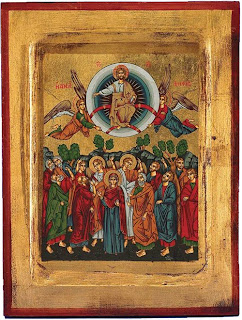
The notes on Acts are merely comments that were made in our Adult Class at St. Michael Orthodox in Louisville. They are in no way comprehensive, and no substitution for reading the text. When posting them online, I will try to pretty them up a little so that they are more comprehensible than the notes I would use while teaching. In effect the book of Acts is Luke part 2. This becomes apparent when comparing the introductions of both books. Luke addresses each to a person named Theophilus. The identity of the man is unknown, and some surmise it was a catechumen in the early church or because it means “lover of God” the name could refer to a generic new Christian or catechumen. Luke was a physician and traveling companion of Paul; so many parts of the book are first hand accounts. He was a Gentile and is the only Gentile writer in Scripture The book was written n the 60’s. We can determine this because he neither mentions the destruction of Jerusalem in 70 nor mentions the martyrd...